Table of Contents
- Introduction to Artificial Intelligence
- What Is Artificial Intelligence?
- How Artificial Intelligence Works
- Machine Learning Explained
- Neural Networks and Deep Learning
- Big Data and AI Analysis
- Real-Life Examples of AI
- Benefits of Artificial Intelligence
- Challenges and Risks of AI
- The Future of Artificial Intelligence
- Frequently Asked Questions
Artificial Intelligence (AI) has rapidly become one of the most powerful and transformative technologies in the modern world.
From smartphones and search engines to healthcare systems and self-driving cars, AI is now deeply integrated into everyday life.
Businesses use artificial intelligence to analyze enormous amounts of data, automate tasks, improve decision-making, and deliver personalized user experiences.
At the same time, governments, researchers, and technology companies continue investing billions of dollars into AI development and innovation.
But what exactly is artificial intelligence? How does it work, and why is it considered one of the most important technologies of the 21st century?
In this beginner-friendly guide, you will learn everything you need to know about AI, including how it works, real-world applications, benefits, challenges, and the future of artificial intelligence.
Introduction to Artificial Intelligence
The concept of artificial intelligence has existed for decades, but recent technological advancements have dramatically accelerated AI development.
Today, AI systems are capable of performing tasks that once required human intelligence.
These tasks include:
- Learning from data
- Recognizing images and speech
- Understanding natural language
- Making predictions
- Solving complex problems
- Automating repetitive processes
As computing power and data availability continue improving, artificial intelligence is becoming more accurate, efficient, and accessible across industries.
What Is Artificial Intelligence?
Artificial Intelligence is a branch of computer science focused on building systems and machines capable of simulating human intelligence.
In simple terms, AI allows computers to learn, think, analyze information, and make decisions based on data.
Main Characteristics of AI
- Learning from experience
- Recognizing patterns
- Processing language
- Problem-solving
- Decision-making
Unlike traditional software programs that follow fixed instructions, AI systems can improve their performance over time by learning from new data.
For example, when your smartphone predicts the next word while typing or when Netflix recommends movies based on your interests, artificial intelligence is working behind the scenes.
How Artificial Intelligence Works
Artificial intelligence works by combining algorithms, mathematical models, and massive amounts of data.
AI systems analyze data, identify patterns, and use those patterns to make predictions or decisions.
The most important AI technologies include:
- Machine Learning
- Neural Networks
- Deep Learning
- Natural Language Processing
- Computer Vision
These technologies allow machines to simulate aspects of human learning and reasoning.

Machine Learning Explained
Machine Learning (ML) is one of the core components of artificial intelligence.
Machine learning enables computers to learn from data without being explicitly programmed for every task.
How Machine Learning Works
Machine learning systems are trained using large datasets.
By analyzing patterns within the data, the system gradually improves its ability to make predictions or classifications.
Examples of Machine Learning
- Email spam filters
- Fraud detection systems
- Product recommendations
- Image recognition
- Search engine algorithms
The more data a machine learning system processes, the more accurate it becomes.
Neural Networks and Deep Learning
Neural networks are advanced mathematical models inspired by the structure of the human brain.
They consist of interconnected layers of nodes that process information and identify complex patterns.
What Neural Networks Are Used For
- Speech recognition
- Image recognition
- Language translation
- Autonomous vehicles
- AI chatbots
Deep learning is a specialized form of machine learning that uses large neural networks to process massive datasets.
Deep learning has been responsible for many recent breakthroughs in AI technology.
Big Data and AI Analysis
Artificial intelligence relies heavily on data.
Modern AI systems process enormous volumes of information known as “Big Data.”
Why Big Data Matters
- Improves prediction accuracy
- Identifies hidden patterns
- Enhances machine learning performance
- Supports real-time decision-making
Without large datasets, modern AI systems would not function effectively.
Data quality and availability are critical factors in AI development.

Real-Life Examples of AI
Artificial intelligence is already used in countless industries and applications.
Voice Assistants
Virtual assistants such as Siri and Google Assistant use AI to understand voice commands and respond intelligently.
Recommendation Systems
Streaming services and online stores use AI-powered recommendation systems to suggest content and products based on user preferences.
Self-Driving Cars
Autonomous vehicles rely on computer vision, machine learning, and sensor analysis to detect obstacles and make driving decisions.
Machine Translation
AI translation systems can instantly translate text between languages.
Healthcare Applications
AI helps doctors analyze medical images, detect diseases early, and improve patient care.
Smartphones and Social Media
AI powers facial recognition, personalized feeds, targeted advertising, and predictive text features.
Benefits of Artificial Intelligence
Artificial intelligence offers numerous advantages across industries.
Increased Efficiency
AI can automate repetitive tasks and significantly improve productivity.
Better Data Analysis
AI systems analyze vast amounts of data quickly and accurately.
Improved Decision-Making
Organizations use AI predictions and analytics to make smarter business decisions.
Enhanced User Experience
AI enables personalized services and intelligent recommendations.
Healthcare Advancements
AI supports medical research, diagnostics, and treatment planning.
Challenges and Risks of AI
Despite its many benefits, artificial intelligence also raises important concerns.
Privacy and Data Security
AI systems often require large amounts of personal data, raising concerns about privacy protection.
Impact on Jobs
Automation may replace some repetitive jobs and transform traditional industries.
However, AI is also expected to create new careers in technology and data science.
Ethical Concerns
Bias in AI algorithms can lead to unfair outcomes if systems are trained on biased data.
Regulation and Governance
Governments and organizations must develop ethical guidelines and regulations to ensure responsible AI use.
The Future of Artificial Intelligence
Artificial intelligence is evolving rapidly and will likely shape nearly every industry in the future.
Future AI Applications
- Healthcare and medical research
- Smart cities
- Autonomous transportation
- Robotics and automation
- Personalized education
- Climate change analysis
Experts believe AI will continue improving productivity, scientific research, and global innovation.
At the same time, society must carefully address ethical, legal, and economic challenges associated with advanced AI systems.

Final Thoughts
Artificial intelligence is one of the most important technologies of the modern era.
From machine learning and neural networks to self-driving cars and personalized recommendations, AI is transforming how people live and work.
While artificial intelligence introduces important challenges related to privacy, jobs, and ethics, its potential to improve industries and solve complex problems is enormous.
Understanding AI today will help individuals, businesses, and governments prepare for a future increasingly shaped by intelligent technologies.

Frequently Asked Questions
What is Artificial Intelligence in simple terms?
Artificial intelligence refers to computer systems that can perform tasks requiring human-like intelligence such as learning, problem-solving, and decision-making.
What is Machine Learning?
Machine learning is a branch of AI that enables systems to learn from data and improve over time.
Where is AI used today?
AI is used in smartphones, healthcare, self-driving cars, social media, online shopping, and recommendation systems.
Can AI replace human jobs?
AI may automate some repetitive jobs, but it is also expected to create new opportunities in technology and data science.
Why is AI important for the future?
AI has the potential to improve productivity, innovation, healthcare, education, and scientific research worldwide.In recent years, Artificial Intelligence (AI) has become one of the most powerful and transformative technologies in the modern world. From smartphones and search engines to healthcare systems and self-driving cars, AI is now a part of our daily lives.
Businesses use artificial intelligence to analyze massive amounts of data and improve decision-making, while applications rely on AI to provide personalized and intelligent experiences for users.
But what exactly is artificial intelligence? How does it work, and why is it so important for the future? In this beginner-friendly guide, we will explain everything you need to know about AI in simple terms.
What is Artificial Intelligence?
Artificial Intelligence is a branch of computer science that focuses on building systems and machines capable of performing tasks that normally require human intelligence.
These tasks may include:
-
Learning from experience
-
Recognizing patterns
-
Understanding language
-
Solving problems
-
Making decisions
In simple terms, AI allows machines to simulate human thinking and learning processes.
For example, when your phone suggests the next word while typing, or when a video platform recommends content based on your interests, AI is working behind the scenes.
How Does Artificial Intelligence Work?
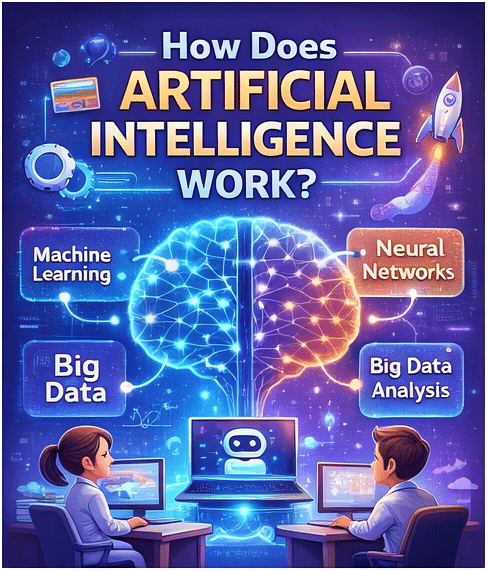
Artificial intelligence works by combining several technologies and algorithms that enable machines to process data and learn from it. The most important AI technologies include:
1. Machine Learning (ML)
Machine learning is one of the core components of AI. It allows systems to learn from data and improve their performance over time without being explicitly programmed.
For example, a machine learning system can analyze thousands of images to learn how to recognize objects such as cars, animals, or people.
2. Neural Networks
Neural networks are mathematical models inspired by the structure of the human brain. They consist of layers of connected nodes that process information and identify patterns in large datasets.
Neural networks are widely used in advanced AI applications such as image recognition, speech recognition, and language translation.
3. Big Data Analysis
Artificial intelligence relies heavily on large volumes of data. By analyzing huge datasets, AI systems can identify patterns, trends, and insights that would be impossible for humans to detect manually.
The more data an AI system processes, the better it becomes at making accurate predictions.
Real-Life Examples of Artificial Intelligence
Artificial intelligence is already used in many industries and everyday applications. Some common examples include:
Voice Assistants
Voice assistants like Siri or Google Assistant use AI to understand voice commands and respond to user requests.
Recommendation Systems
Streaming platforms and online stores use AI-powered recommendation systems to suggest movies, products, or music based on user preferences.
Self-Driving Cars
Autonomous vehicles rely on AI technologies such as computer vision and machine learning to detect obstacles, interpret road conditions, and make driving decisions.
Machine Translation
AI-powered translation tools can instantly translate text between languages, helping people communicate across different cultures.
Healthcare Applications
AI is also used in healthcare to analyze medical data, detect diseases early, and assist doctors in making accurate diagnoses.
Benefits of Artificial Intelligence
Artificial intelligence offers numerous advantages that are transforming businesses and industries around the world.
Increased Efficiency
AI can automate repetitive tasks and significantly speed up processes that would normally take humans much longer.
Better Data Analysis
AI systems can analyze vast amounts of data quickly and accurately, helping organizations make informed decisions.
Improved Decision-Making
By analyzing patterns and predicting outcomes, AI can assist businesses and governments in making smarter decisions.
Enhanced User Experience
AI enables personalized services, such as content recommendations, smart assistants, and customized online experiences.
Challenges and Concerns of Artificial Intelligence
Despite its many benefits, artificial intelligence also raises several important challenges.
Privacy Issues
AI systems often rely on large amounts of personal data, which can raise concerns about privacy and data security.
Impact on Jobs
Automation powered by AI may replace some traditional jobs, especially repetitive or manual tasks.
However, it is also expected to create new job opportunities in technology, data science, and AI development.
Ethical and Regulatory Concerns
As AI becomes more powerful, governments and organizations must ensure that it is used responsibly and ethically.
Proper regulations are needed to prevent misuse and ensure transparency in AI systems.
The Future of Artificial Intelligence
Artificial intelligence is still evolving rapidly. In the coming years, we are likely to see even more advanced AI applications in areas such as:
-
Healthcare and medical research
-
Education and personalized learning
-
Smart cities and transportation
-
Robotics and automation
-
Climate change and environmental monitoring
As AI technology continues to improve, it will play a major role in shaping the future of society.
Conclusion
Artificial intelligence is one of the most important technologies of the 21st century. It allows machines to learn, analyze data, and perform complex tasks that once required human intelligence.
While AI presents challenges such as privacy concerns and job displacement, its potential benefits are enormous.
Understanding artificial intelligence today will help individuals and businesses prepare for a future where AI plays an increasingly central role in everyday life.