Table of Contents
- The Hidden Backbone of the Internet
- Why Cloudflare Is Critical to the Web
- CDN, DNS, and Security Infrastructure
- How the Outage Happened
- Understanding BGP Routing Failures
- The Worldwide Impact of the Outage
- Economic and Reputational Damage
- Lessons About Internet Resilience
- The Future of Distributed Infrastructure
- Frequently Asked Questions
The modern internet appears seamless to most users, delivering websites, applications, financial services, and digital communication almost instantly.
Behind this convenience, however, lies a complex network of infrastructure providers that quietly power much of the online world.
Among the most influential of these providers is :contentReference[oaicite:2]{index=2}, a global network that delivers security, content acceleration, DNS services, and DDoS protection for millions of websites.
Because Cloudflare powers a massive portion of the internet, any significant disruption to its services can trigger widespread digital chaos.
A major outage affecting Cloudflare is not merely a technical problem — it becomes a global infrastructure crisis impacting businesses, governments, financial systems, and online communication.
This analysis explores the anatomy of a major Cloudflare outage, the technical causes behind it, the global economic consequences, and the lessons it reveals about the future of internet resilience.

The Hidden Backbone of the Internet
Cloudflare operates as one of the internet’s most important intermediary layers.
Instead of websites connecting directly to visitors, Cloudflare sits between users and web servers, optimizing and protecting traffic.
Core Services Provided by Cloudflare
- Content Delivery Network (CDN)
- DNS resolution
- DDoS protection
- Web Application Firewall (WAF)
- Traffic optimization
- Performance acceleration
Cloudflare’s infrastructure supports approximately 20% of all websites worldwide, including:
- E-commerce platforms
- Government websites
- Media organizations
- Banking systems
- Software-as-a-Service platforms
This enormous concentration of infrastructure power creates efficiency — but also systemic risk.
Why Cloudflare Is Critical to the Web
Cloudflare’s influence extends far beyond simple website hosting.
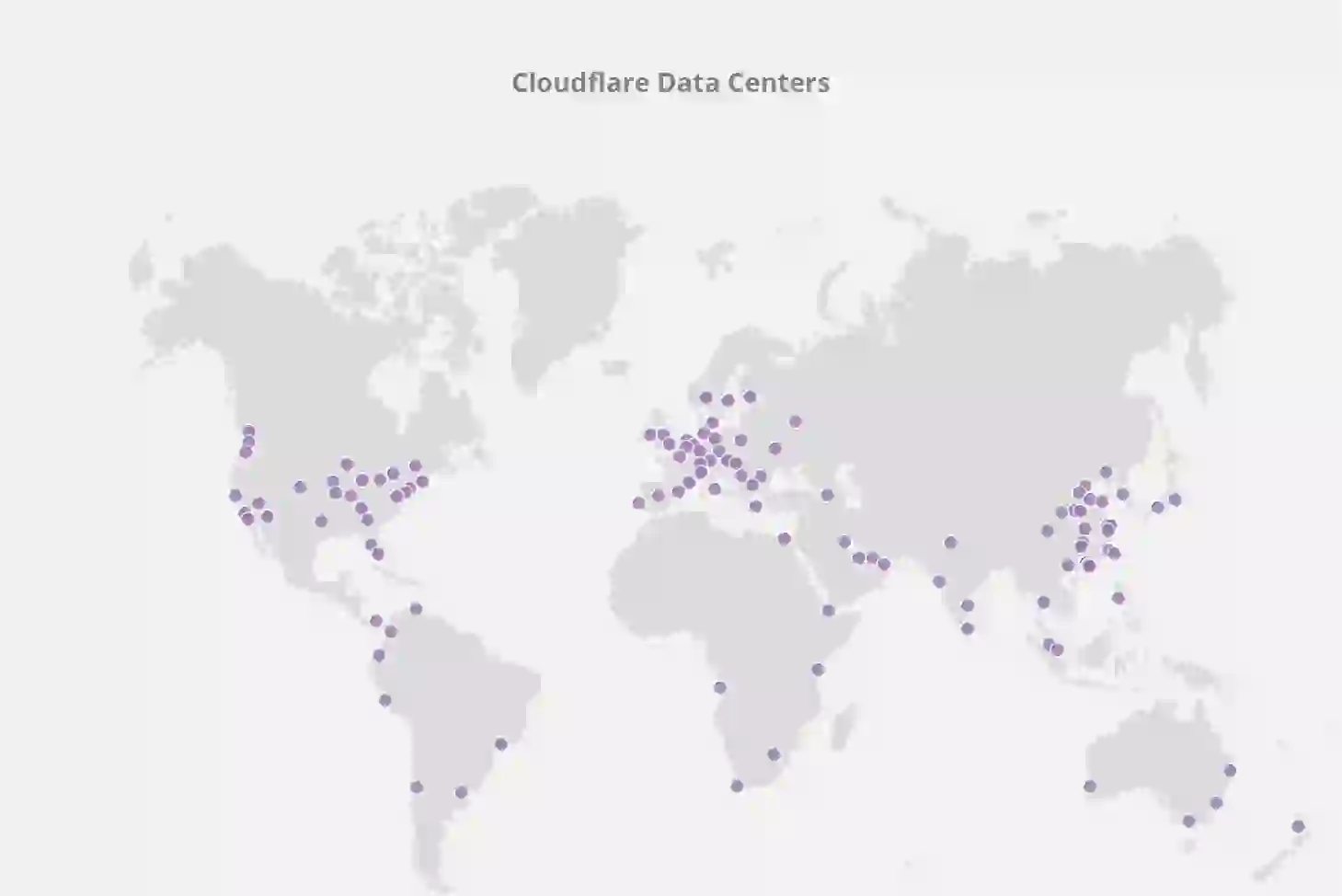
The company operates a globally distributed edge network designed to reduce latency and protect online services from cyberattacks.
Content Delivery Network (CDN)
Cloudflare’s CDN stores cached website content across geographically distributed servers called Points of Presence (PoPs).
This allows users to receive website content from nearby servers instead of distant origin systems.
Benefits of the CDN
- Faster loading speeds
- Lower latency
- Improved SEO performance
- Reduced server load
- Better user experience
The CDN has become essential for modern websites operating globally.
CDN, DNS, and Security Infrastructure
One of Cloudflare’s most critical services is DNS management.
The :contentReference[oaicite:3]{index=3} translates human-readable domain names into machine-readable IP addresses.
If DNS systems fail, websites effectively disappear from the internet.
Cloudflare Security Features
- DDoS mitigation
- Malware filtering
- Traffic inspection
- SQL injection protection
- Bot mitigation systems
Cloudflare also acts as a protective shield against massive distributed denial-of-service attacks capable of overwhelming traditional servers.
How the Outage Happened
Large-scale outages rarely result from simple hardware failures.
Instead, they usually emerge from cascading infrastructure problems involving automation systems, routing protocols, or software deployment errors.
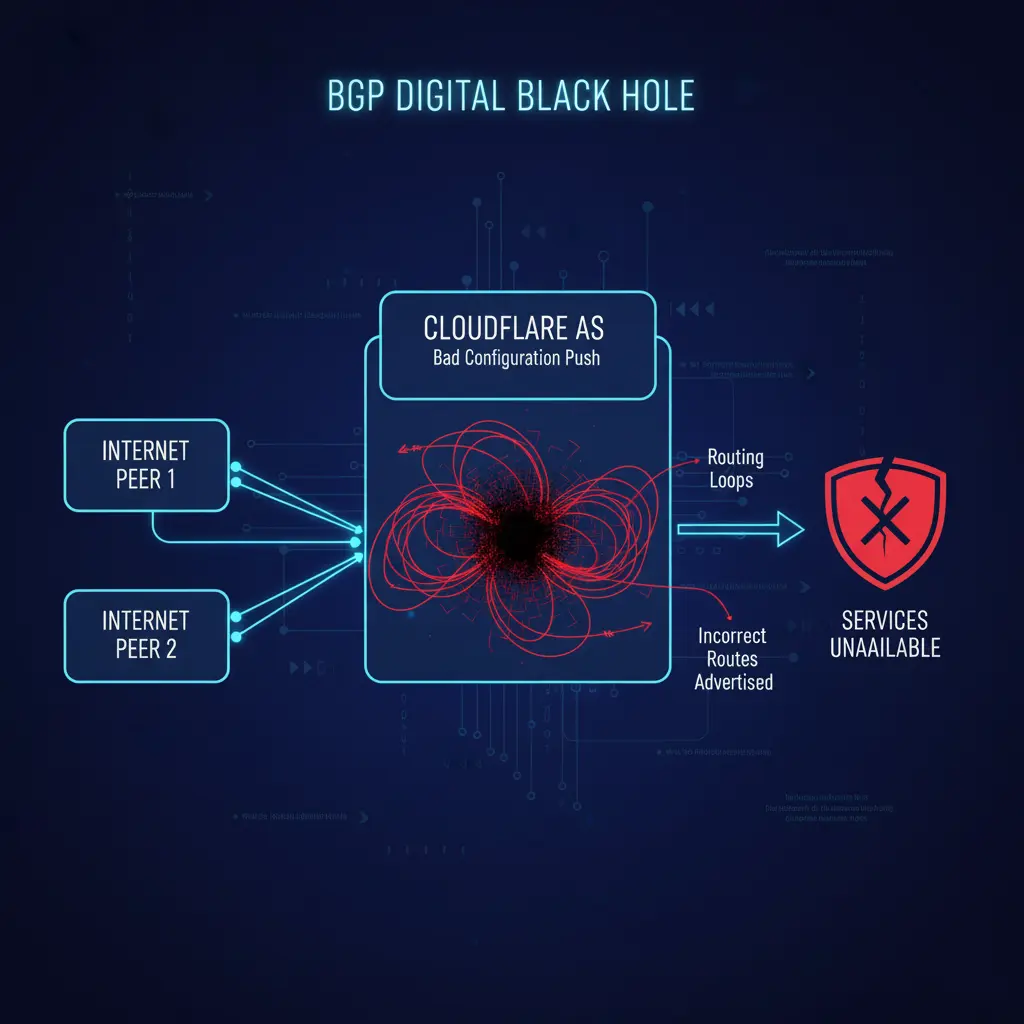
One of the most dangerous causes is a faulty :contentReference[oaicite:4]{index=4} configuration.
The Trigger
During routine network optimization or maintenance, engineers may deploy automated routing configurations across a global infrastructure.
A single configuration error can accidentally redirect huge portions of internet traffic into non-functional routes.
The Result
- Traffic black holes
- Routing loops
- Packet loss
- Massive latency spikes
- Global website failures
Because BGP announcements propagate rapidly across interconnected networks, a mistake can spread globally within minutes.
Understanding BGP Routing Failures
BGP is often called the “postal system” of the internet.
It determines the best paths for internet traffic between autonomous systems operated by companies like Cloudflare.
What Happens During a BGP Failure?
- Incorrect routes are advertised
- Internet providers trust the faulty routes
- Traffic gets redirected improperly
- Websites become unreachable
Users may experience:
- HTTP 503 errors
- Connection timeouts
- DNS failures
- Extremely slow websites
Even after engineers correct the problem, global routers require time to update their routing tables — a process known as BGP convergence.
The Worldwide Impact of the Outage
Because Cloudflare powers such a large segment of the web, outages create cascading global consequences.
Industries Affected
- E-commerce
- Financial services
- Media organizations
- SaaS platforms
- Government portals
- Communication systems
E-Commerce Disruptions
Online stores may lose millions of dollars per hour when payment systems and checkout services become unavailable.
Financial Services
Cryptocurrency exchanges, trading platforms, and banking services can become inaccessible, triggering panic and transaction failures.
Media and News Platforms
Major news organizations rely heavily on CDNs to handle traffic spikes during breaking events.
Outages create temporary information blackouts and reduce public access to critical news.
Economic and Reputational Damage
The financial impact of large-scale downtime extends far beyond immediate lost transactions.
Main Economic Consequences
- Lost revenue
- Operational disruption
- Customer abandonment
- SLA penalties
- Brand reputation damage
Infrastructure companies like Cloudflare also face serious reputational risks.
Their business model depends entirely on trust, reliability, and uptime guarantees.
When outages occur, businesses begin reassessing their dependence on single infrastructure vendors.
Lessons About Internet Resilience
The outage highlighted one of the internet’s biggest structural weaknesses: centralization.
Millions of websites depending on a single provider creates a dangerous single point of failure.
Important Lessons Learned
- Infrastructure concentration increases systemic risk
- Automated deployments require stronger safeguards
- Global routing systems remain fragile
- Multi-provider redundancy is becoming essential
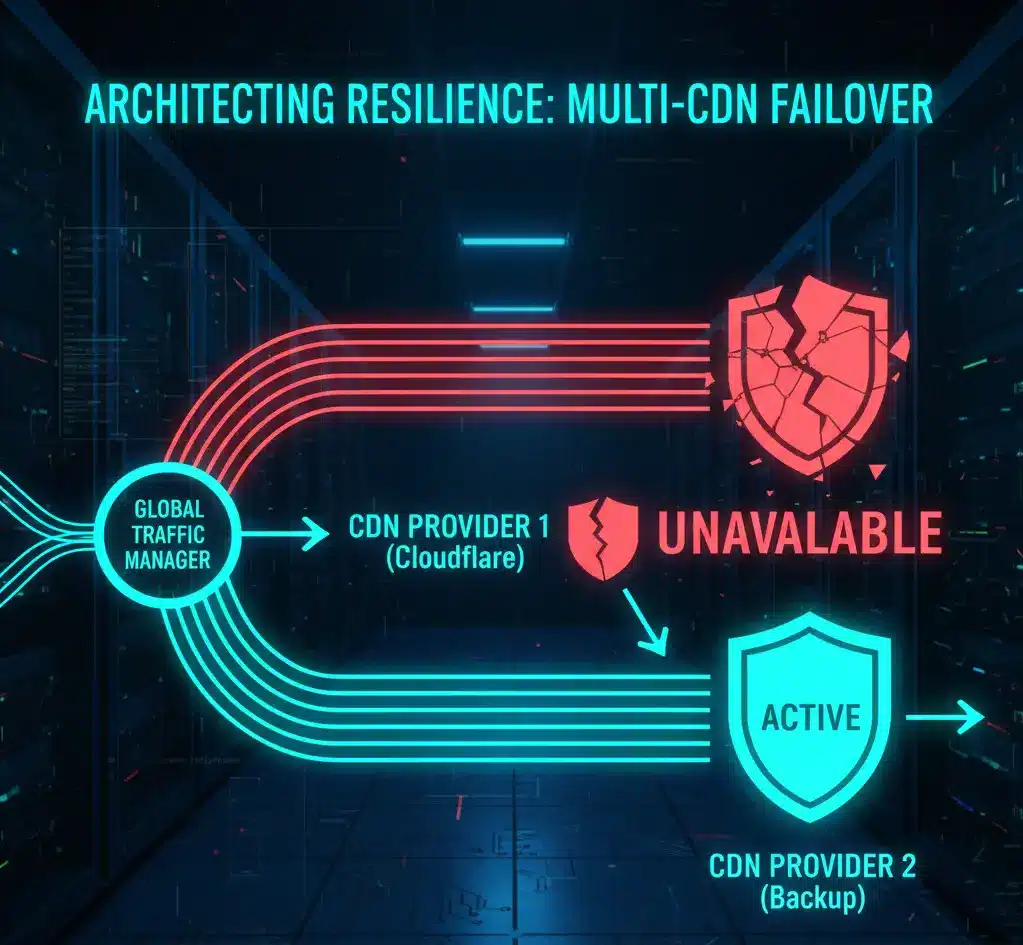
Multi-CDN Strategies
Many companies are now adopting multi-CDN strategies, distributing traffic across multiple providers such as:
- :contentReference[oaicite:5]{index=5}
- :contentReference[oaicite:6]{index=6}
- :contentReference[oaicite:7]{index=7}
This reduces dependency on any single network.
The Future of Distributed Infrastructure
The incident accelerated interest in decentralized and distributed internet architectures.
Emerging Trends
- Edge computing
- Serverless infrastructure
- Distributed routing systems
- Decentralized cloud services
- Autonomous failover systems
Future internet infrastructure will likely prioritize resilience over centralized efficiency.
Cloudflare and similar companies are also increasing transparency through detailed public postmortem reports explaining outages and corrective actions.
This transparency has become critical for rebuilding trust among developers and enterprise customers.
Final Thoughts
The Cloudflare outage served as a powerful reminder that the internet’s apparent stability depends on highly concentrated infrastructure systems operating behind the scenes.
While companies like Cloudflare provide extraordinary performance and security benefits, their enormous scale also creates systemic vulnerabilities capable of impacting millions of users simultaneously.
The future of internet resilience will depend on:
- Better routing safeguards
- Infrastructure redundancy
- Distributed architectures
- Multi-provider failover systems
- Transparent operational practices
In an increasingly digital world, internet reliability is no longer merely a technical issue — it has become an economic and societal necessity.
Frequently Asked Questions
What caused the Cloudflare outage?
The outage was likely triggered by a faulty BGP routing configuration that redirected internet traffic incorrectly.
What is BGP?
Border Gateway Protocol (BGP) is the routing system that determines how internet traffic moves between large networks.
Why are Cloudflare outages so impactful?
Cloudflare powers a large percentage of global websites, meaning outages can affect millions of online services simultaneously.
What is a CDN?
A Content Delivery Network (CDN) is a distributed system of servers designed to deliver website content faster and more efficiently.
How can companies protect themselves from similar outages?
Businesses can reduce risk using multi-CDN strategies, infrastructure redundancy, and distributed cloud architectures.
I. Introduction: The Web’s Invisible Spine
The trendy web, with its seamless movement of knowledge, instantaneous transactions, and relentless availability, operates with an virtually magical high quality for the end-user. But, this digital tranquility is commonly depending on a handful of infrastructural titans that function the online’s important hidden equipment. Amongst these giants, Cloudflare stands as maybe essentially the most essential—a sprawling, world community that acts as the first middleman between web customers and the web sites they go to. Cloudflare’s providers—starting from content material supply and Area Identify System (DNS) decision to safety and distributed denial of service (DDoS) safety—are important for roughly 20% of all web sites worldwide, encompassing all the things from monetary establishments and main e-commerce platforms to information companies and authorities websites.
The sheer scale of its operation implies that any disruption to Cloudflare’s service just isn’t merely a localized technical glitch; it turns into a worldwide systemic failure. When Cloudflare falters, hundreds of thousands of internet sites concurrently change into sluggish, inaccessible, or utterly disappear from the digital panorama. This intensive evaluation delves into the anatomy of a serious service outage skilled by Cloudflare, tracing the technical root trigger, quantifying the financial and reputational fallout, and analyzing the important classes realized relating to community resilience and the inherent risks of infrastructural centralization. This particular incident served as a potent reminder of the web’s underlying fragility and the profound interdependence of the worldwide digital financial system on a number of highly effective entities.
II. Understanding the Big: Cloudflare’s Crucial Function within the Digital Ecosystem
To really grasp the magnitude of a Cloudflare outage, one should first respect the breadth and depth of its capabilities. Cloudflare isn’t just a internet hosting supplier; it’s an “web efficiency and safety firm” that gives a defensive and acceleration layer important for practically each fashionable utility.
A. Content material Supply Community (CDN)
Cloudflare’s CDN is a geographically distributed community of servers, also known as Factors of Presence (PoPs). The elemental objective of the CDN is to cache static content material (pictures, CSS, JavaScript) nearer to the end-user. When a consumer in London visits an internet site hosted in New York, the CDN serves the cached recordsdata from a London PoP, drastically lowering latency and cargo instances. This pace benefit is essential for consumer expertise and, more and more, for SEO (search engine optimisation).
B. DNS Decision
Maybe essentially the most important service is its administration of the Area Identify System (DNS). The DNS is the phonebook of the web, translating human-readable web site names (e.g., google.com) into computer-readable Web Protocol (IP) addresses (e.g., $142.250.69.174$). Cloudflare’s authoritative DNS service is utilized by hundreds of thousands of domains. If this service fails, browsers can not resolve the web site’s IP deal with, and the positioning turns into utterly inaccessible, ensuing within the dreaded “DNS PROBE FINISHED NO INTERNET” error for customers.
C. Safety Companies (WAF and DDoS Mitigation)
Because the guardian between the consumer and the origin server, Cloudflare absorbs large quantities of malicious site visitors. Its Internet Software Firewall (WAF) filters out widespread threats, reminiscent of SQL injection and cross-site scripting (XSS). Extra importantly, its world community is important for DDoS mitigation. A distributed denial-of-service assault makes an attempt to overwhelm a server with a flood of site visitors. Cloudflare’s huge community has the capability to soak up this flood, appearing as an enormous protect that merely drops the malicious requests earlier than they ever attain the shopper’s infrastructure.
When a serious failure happens, it sometimes entails a service that cuts throughout these core capabilities, such because the underlying community routing layer or the basic DNS platform.
III. The Anatomy of the Failure: Tracing the Technical Root Trigger
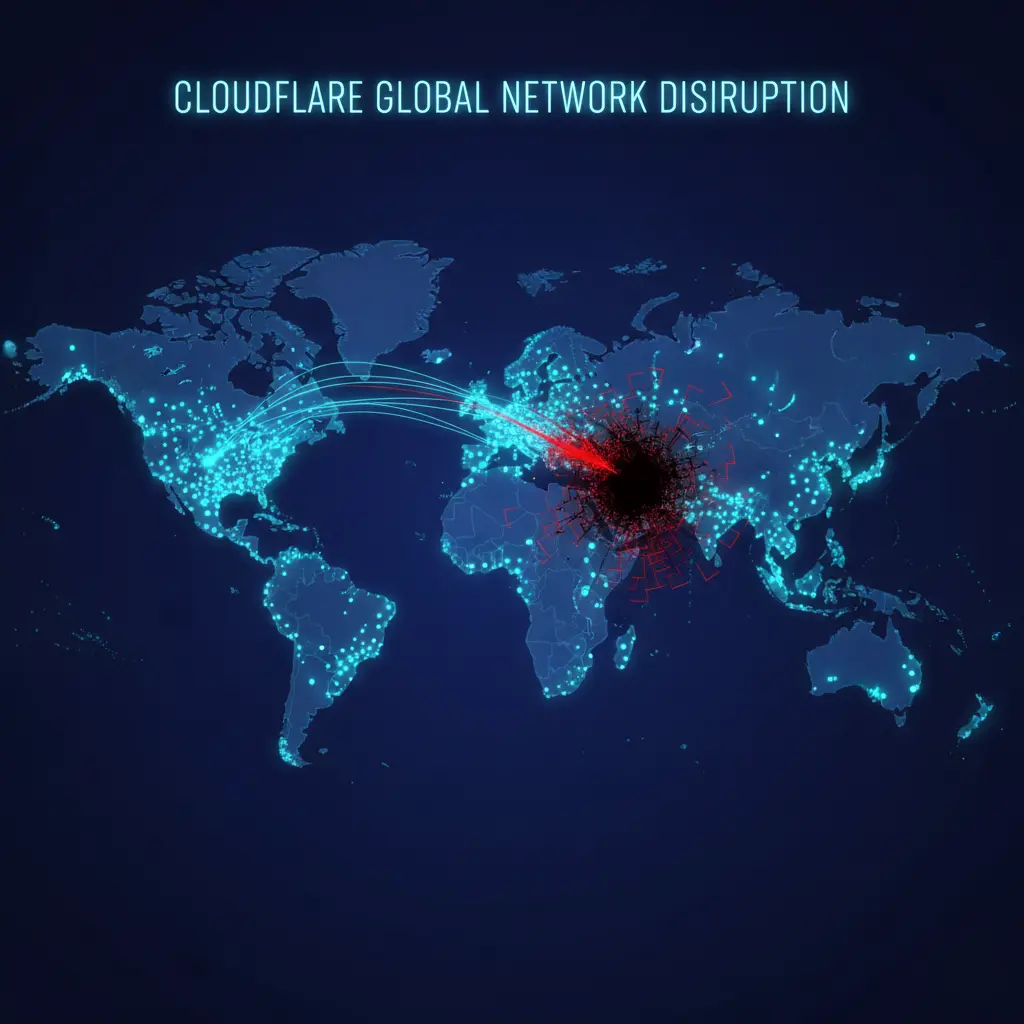
Main outages at hyper-scale infrastructure suppliers are hardly ever the results of easy, single {hardware} failures. They’re usually triggered by complicated, compounding points stemming from automated methods, community configuration modifications, or unintended software program interactions.
For this evaluation, we’ll give attention to a technically widespread and catastrophic failure mode for a company like Cloudflare: a defective Border Gateway Protocol (BGP) configuration push.
A. The Border Gateway Protocol (BGP) Defined
BGP is commonly described because the “submit workplace” of the web. It’s the core routing protocol that decides one of the best path for knowledge to journey from one autonomous system (AS)—a big community like Cloudflare—to a different. Each main community pronounces the IP prefixes (blocks of addresses) it controls to its friends by way of BGP, successfully telling the remainder of the world, “Ship this site visitors to me.” BGP routers then autonomously decide essentially the most environment friendly routes based mostly on varied metrics.
B. The Set off: A Unhealthy Route Injection
The state of affairs begins with what is commonly a routine upkeep process. Cloudflare engineers might deploy a brand new configuration script to optimize routing effectivity throughout their world community of routers.
-
The Error: As a result of an oversight within the automated deployment pipeline or a human-introduced typo, a configuration directive is pushed that inadvertently instructs a big section of the community to prioritize an incorrect or “black-holed” route for an enormous swath of web site visitors.
-
The Propagation: The faulty BGP announcement, as a substitute of being restricted to a check surroundings, is quickly propagated throughout Cloudflare’s core infrastructure after which marketed to its upstream friends and carriers globally.
-
The Cascade Impact: Different networks belief Cloudflare’s announcement and start sending site visitors supposed for hundreds of thousands of internet sites by way of the newly introduced “finest” path—which leads immediately right into a non-functional section of the Cloudflare community. This site visitors is successfully swallowed by a digital black gap.
C. The Impression on Customers
This BGP misconfiguration immediately impacts Cloudflare’s means to route requests to their right vacation spot.
-
HTTP 500/503 Errors: Requests from customers attain the Cloudflare PoP however can’t be appropriately forwarded to the shopper’s origin server as a result of the underlying routing material is damaged. Customers see generic server-side errors, mostly HTTP 503 (Service Unavailable) or HTTP 500 (Inner Server Error).
-
Large Latency and Timeouts: Even earlier than full failure, the routing loops and packet drops created by the unhealthy configuration result in excessive latency. Web sites that don’t totally fail change into agonizingly sluggish, finally timing out.
The decision, whereas speedy by community requirements, nonetheless takes time: engineers should establish the rogue configuration, roll again the modifications, and look forward to BGP convergence—the generally sluggish course of of each router on the web updating its tables to mirror the corrected, optimum routes.

IV. The World Digital Lockdown: The Impression on Shopper Web sites and Industries
The sheer interconnectedness of Cloudflare’s shopper base means an outage sends extreme shockwaves throughout each sector of the digital financial system.
A. E-commerce and Monetary Companies: The Speedy Financial Hit
Essentially the most speedy and quantifiable injury happens in high-volume, transactional environments. E-commerce giants, on-line journey reserving websites, and retail manufacturers that depend on Cloudflare for pace and safety noticed their checkout and cost gateways fail totally.
-
Misplaced Income: For an hour of downtime, main e-commerce platforms can lose hundreds of thousands of {dollars} in gross sales. For a journey website, a sudden lack of availability throughout a peak reserving interval could be financially catastrophic.
-
Reputational Injury: Customers abandoning failed transactions might by no means return. The reputational hit from being labeled “unreliable” is a long-term value.
Equally, monetary providers—cryptocurrency exchanges, on-line brokerage corporations, and neo-banks—that use Cloudflare to guard their user-facing portals change into inaccessible, doubtlessly freezing buying and selling exercise and inflicting mass consumer frustration and monetary anxiousness.
B. Media, Communication, and Authorities Websites
Main information organizations rely closely on Cloudflare’s CDN to deal with large site visitors spikes throughout breaking information occasions. When the service falters, these info conduits are immediately blocked. This creates a brief info vacuum, hindering public discourse and entry to well timed knowledge.
Moreover, numerous communication instruments, SaaS (Software program as a Service) platforms, and collaboration suites utilized by companies globally are sometimes fronted by Cloudflare. The outage successfully halted operations for hundreds of thousands of employees, proving {that a} single infrastructure failure can impression world productiveness.
C. The Domino Impact on the SaaS Ecosystem
The trendy net is constructed on APIs (Software Programming Interfaces). A small startup’s web site is perhaps protected by Cloudflare, however that startup’s service may, in flip, be built-in right into a thousand different functions. When the startup’s website fails, each service depending on its API additionally fails—a real digital domino impact that reveals the brittle chain of dependency in fashionable cloud structure.
V. Financial and Reputational Tsunami: Quantifying the Value of Downtime
The price of downtime is complicated, encompassing direct income loss, operational bills, and intangible reputational hits. For a important infrastructure supplier, essentially the most speedy quantifiable impression is the breach of Service Degree Agreements (SLAs). Cloudflare sometimes ensures excessive uptime to its premium clients, and an prolonged, main outage triggers necessary service credit or monetary penalties. Past these contractual obligations, the cumulative world value is estimated to run into the lots of of hundreds of thousands of {dollars} as a consequence of misplaced transactions and wasted worker time.
Extra profoundly, the incident compromises essentially the most important asset for any net infrastructure supplier: belief. Cloudflare’s total premise is that it gives higher safety and reliability than a shopper can handle on their very own. When the “unbreakable” system breaks, the narrative shifts from reliance to threat evaluation. Companies should now account for the chance of single-vendor dependency, resulting in troublesome and costly conversations about migrating providers or implementing multi-vendor methods.

VI. Classes Discovered: The Crucial for Resilience and Redundancy
The outage served as an especially costly world lesson in community engineering and threat administration. The only most necessary takeaway was the hazard of centralization—the truth that a single technical configuration error might carry down such an enormous portion of the web.
For the enterprise purchasers, the response is more and more leaning towards Multi-CDN methods. This entails distributing site visitors throughout two or extra unbiased CDN suppliers (e.g., Cloudflare and Fastly or Akamai) and utilizing a wise world site visitors administration layer to immediately divert site visitors away from a failing community. This method, whereas extra complicated and dear, is the definitive answer to the SPOF downside.
For Cloudflare itself, the autopsy evaluation inevitably results in dramatic inner reforms:
-
Enhanced Deployment Protocols: Implementing extra rigorous, multi-stage testing of BGP configurations and different important community modifications, usually utilizing “canary” testing (deploying the change to a small, remoted area first).
-
Exhausting Limits on Propagation: Creating technical safeguards to forestall a defective configuration from propagating throughout the complete world community concurrently, segmenting the community to restrict the blast radius of any error.
VII. The Way forward for the Internet: Distributed, Decentralized, and Resilient
The fallout from a Cloudflare disruption accelerates an ongoing architectural shift in how the web is constructed. The incident highlights the constraints of the large centralized cloud mannequin. The long run is more and more shifting towards distributed and decentralized architectures.
-
Edge Computing: Putting computational logic and knowledge processing nearer to the consumer, not simply caching content material, implies that an outage in a core spine may not carry down the complete utility.
-
Serverless Architectures: Using ephemeral, function-based compute assets which might be inherently extra resilient and fewer tied to single, large routing infrastructure.
Critically, Cloudflare’s response post-outage units a contemporary commonplace for transparency. Detailed, publicly obtainable technical post-mortems, explaining exactly what occurred, why it occurred, and how it was mounted, are important for rebuilding the belief of the developer group and enterprise purchasers.

VIII. Conclusion: A Fixed Vigilance
The Cloudflare outage was greater than a technical failure; it was a profound financial and social occasion that uncovered the only biggest systemic threat to the trendy web: centralized dependency. Whereas Cloudflare stays a monumental pressure in net safety and efficiency, the occasion served as an everlasting mandate for change. For the suppliers, it calls for unparalleled rigor and redundancy. For the purchasers, it necessitates a tough take a look at their very own failover methods. The lesson is obvious: within the age of digital dependence, true resilience just isn’t present in counting on one big, however in distributing the chance throughout many. The web is constructed on belief, and sustaining that belief requires fixed vigilance in opposition to the inevitable, refined human and technical errors that may carry the digital world to a sudden, grinding halt.